
What a PhD in Seaweed Taught Me
I spent years researching seaweed, and I have just submitted my thesis. Here is what I learned about the biology, the chemistry and, most of all, the applications of seaweed, and where I'm going from here.
When I started, I thought seaweed was something you eat in sushi or find tangled on a beach. I now think it is one of the most underused renewable resources we have. It grows fast and needs no farmland, no fresh water and no fertiliser. It also gives us alginate, a polymer that already sits quietly in thousands of everyday products.

Sustainable seaweed harvesting Fucus species
Lesson 1: The biology. Seaweed is built differently
I worked with brown macroalgae (kelp), mainly Laminaria digitata and Laminaria hyperborea. Our kelp was collected by scientific divers in the North Sea.
Brown seaweeds hold alginate in their cell walls, and that gives kelp its flexibility and strength in moving water. Alginate is made of two sugar-like building blocks, mannuronic acid (M) and guluronic acid (G). Their ratio and arrangement decide whether the polymer forms soft, flexible gels or firm, brittle ones. So the same seaweed can give very different materials depending on species, season and how you process it. If you want to understand seaweed in food research or biomaterials, you start with its biology.
Lesson 2: The chemistry. How you extract matters as much as what you extract
Most alginate is extracted with harsh acids, and the process can run for hours. My research asked whether we can do it faster, with safer chemicals and less energy, without damaging the polymer.
Paper 1: Rapid organic acid mechanochemical extraction of alginate from Laminaria digitata (Bioresource Technology, 2026, open access)
Conventional acid pretreatment is typically run with slow agitation for up to 24 hours. We combined food-grade citric acid with simple blade-based mechanical disruption and cut the pretreatment to 6 minutes, with no loss in yield and no change in the M/G ratio. Higher blade speed also made the extract purer. Ash dropped from about 26% to about 12%, so we got cleaner alginate in less time. The setup needs no specialised equipment, which makes it a realistic low-energy, scalable design for a seaweed biorefinery. (DOI)
Paper 2: Pulsed electric field (PEF) assisted extraction and characterization of alginate from Laminaria hyperboreaby ¹H NMR and FTIR analysis (Innovative Food Science & Emerging Technologies, 2026, open access)
PEF is a non-thermal technology already used in food processing. Short, high-voltage pulses open up cell membranes and speed up mass transfer. To our knowledge, this was the first evaluation of PEF for alginate extraction. PEF combined with citric acid increased crude alginate yield, while PEF in water alone preserved the polymer's molecular weight. Across all treatments, NMR and FTIR showed the alginate's chemical structure stayed intact. The trade-off is that you can push for yield or for polymer quality, and the right choice depends on the product you want. (DOI)
The chemistry lesson was that gentler is often smarter. Process conditions leave a fingerprint on the material, and you only see it if you measure purity, viscosity, molar mass and structure, not just yield.
Lesson 3: The most important one is application
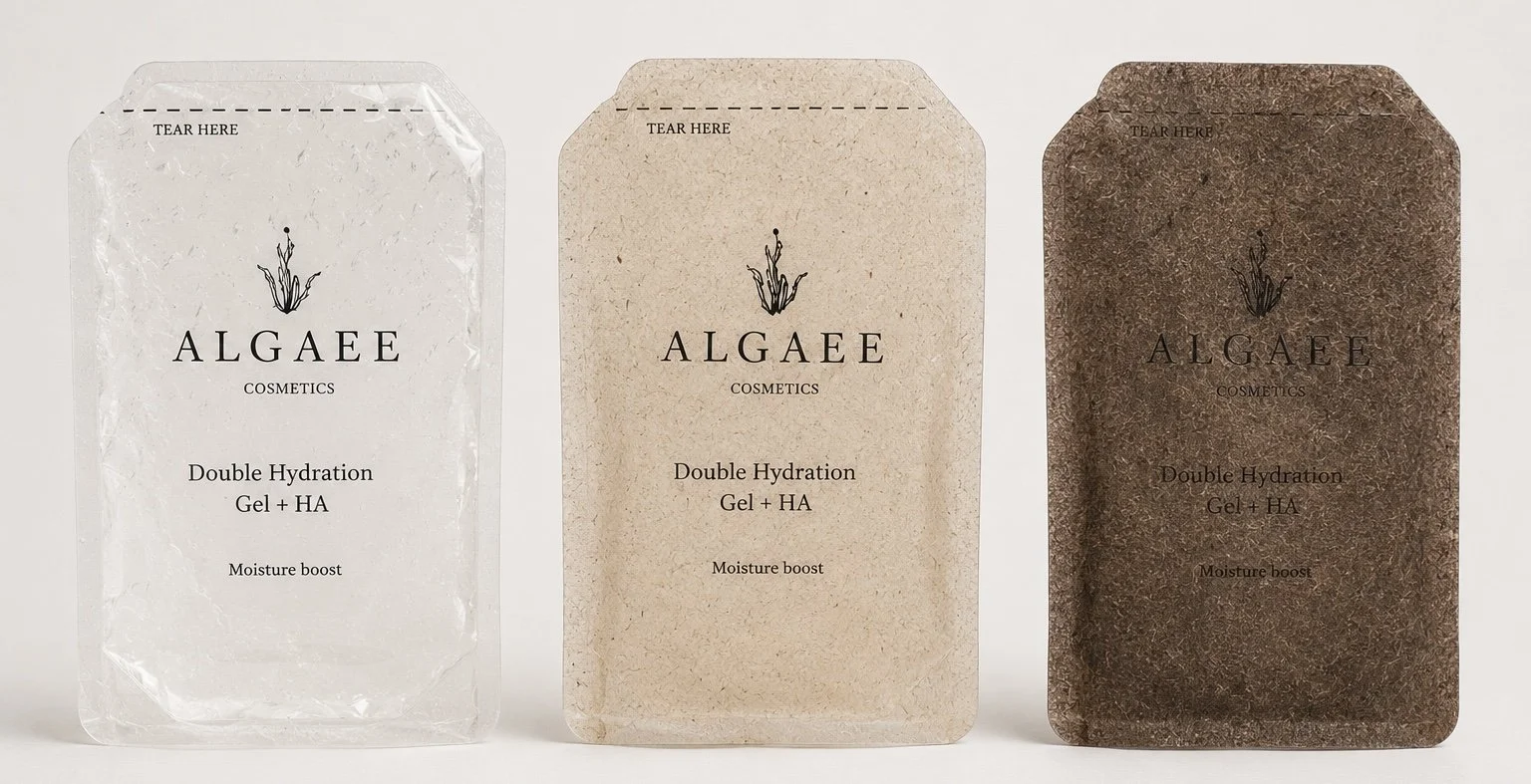
Seaweed bioplastic cosmetic packaging
Alginate is used in food, pharmaceuticals, tissue engineering and biotechnology. It thickens, gels and stabilises. The market is projected to keep growing, and the PEF paper cites an estimate of over USD 1.4 billion by 2032.
What changed my thinking was seeing seaweed as a biorefinery feedstock. One kelp can give alginate, but also fucoidan, laminarin, proteins and polyphenols. If we extract gently and use the whole plant, nothing is wasted. That is where seaweed in food research, cosmetics, packaging and hygiene products meets circular economy thinking. Good reviews to start with are Bojorges et al. on alginate extraction processes and Saji et al. on sustainable alginate extraction.
Seaweed and climate change
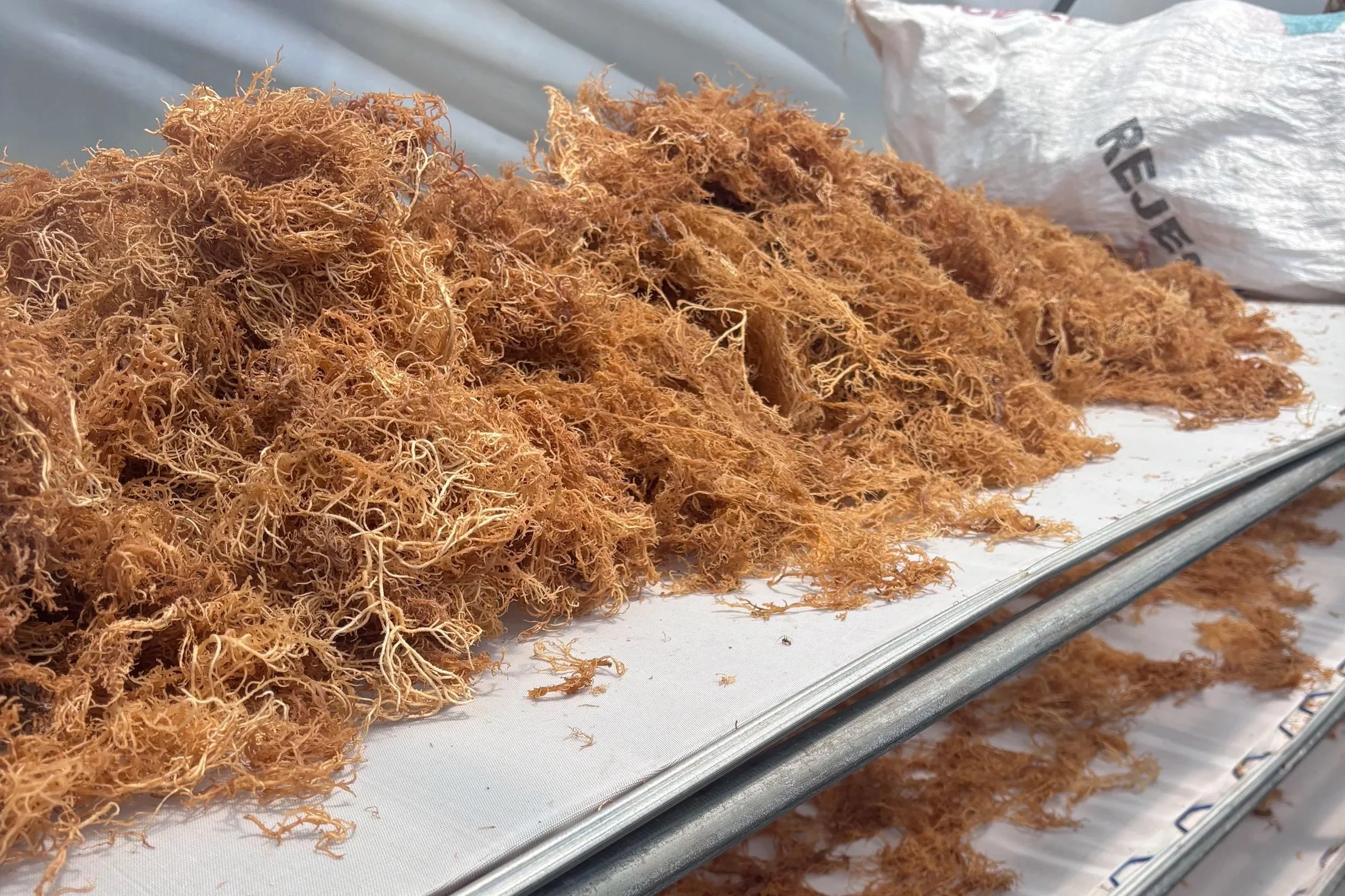
Eucheuma seaweed drying
Seaweed is not a silver bullet for climate change, and I'd distrust anyone who says it is. But the case for it is real. Marine biomass grows without competing for land or freshwater, and it can replace some fossil-based and land-intensive ingredients. Gentler, lower-energy extraction like the methods above matters for this reason: a "green" material only counts if the process behind it is also low-impact. For the wider climate context, see the IPCC.
What else a PhD taught me
Replicates beat enthusiasm. The most exciting result is often an artefact.
Null results are results. In Paper 1, blade speed did not change yield, and that finding was just as useful.
Always ask what's hiding in your number. Crude yield can be inflated by co-extracted impurities, which is why we reported purity-corrected yields.
Where we go from here
The thesis is submitted. Next, I want to move this work from the lab bench towards real products and real supply chains. Focusing on applying seaweed into skincare, working with communities in Kenya to educate on seaweed applications and so much more.
If you work with seaweed or want to, I'd love to hear from you. Read the papers, share them, and tell me what you'd like to see next.
